How the rig works
A paternoster is a feeder rig with the feeder attached to a side branch and the hooklength tied to the end of the main line. Separating the feeder and bait can help reduce tangles, though no rig is completely tangle-proof.
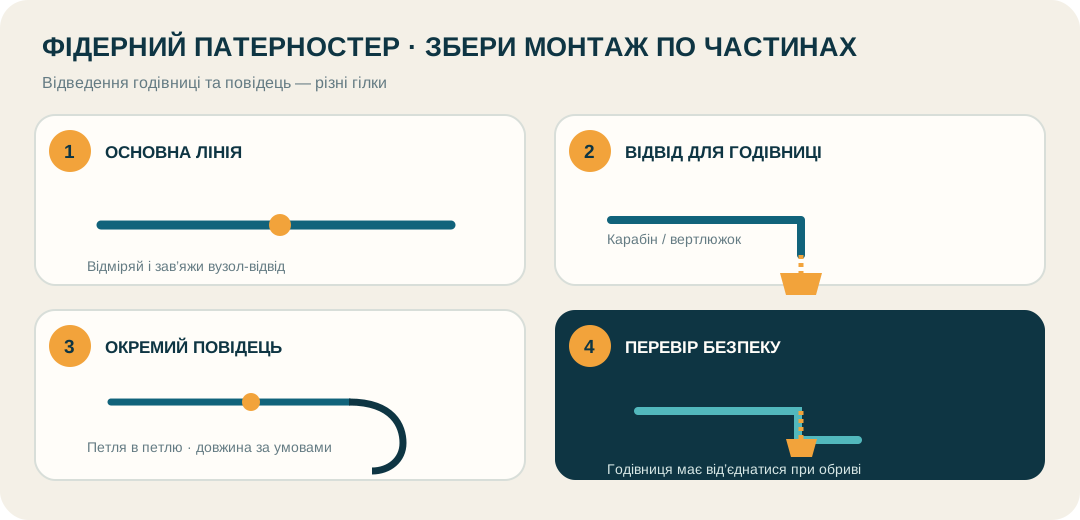
Start with main line or a dedicated rig boom, a feeder swivel, a hook and hooklength. The lengths below are only a guide—adapt them to the flow, bottom, casting distance and local rules.
Tie the loop and feeder branch
- Tie a figure-of-eight loop at the end of the main line, leaving a loop about 15–25 cm long.
- If needed, cut one side of the loop to make a short side branch. Attach the feeder to it with a swivel or snap.
- Make a small loop or add a swivel at the free end of the main line for the hooklength.
- Attach a hooklength of about 40–80 cm with a loop-to-loop connection or swivel, then tie a hook to its end.

Test the rig and keep it fish-safe
Lay the rig out before casting. The feeder branch and hooklength should separate freely without crossing. If it tangles often, adjust the branch or hooklength and check that your casting motion is smooth.
For fish safety: do not leave a fish tethered to a heavy feeder if the main line breaks. Use a fish-safe rig permitted by local rules—for example, a free-running feeder connection or a weak link that releases the feeder if it snags. Check local restrictions on rig types and hook counts.